AR 102: Research Methods in Social Sciences
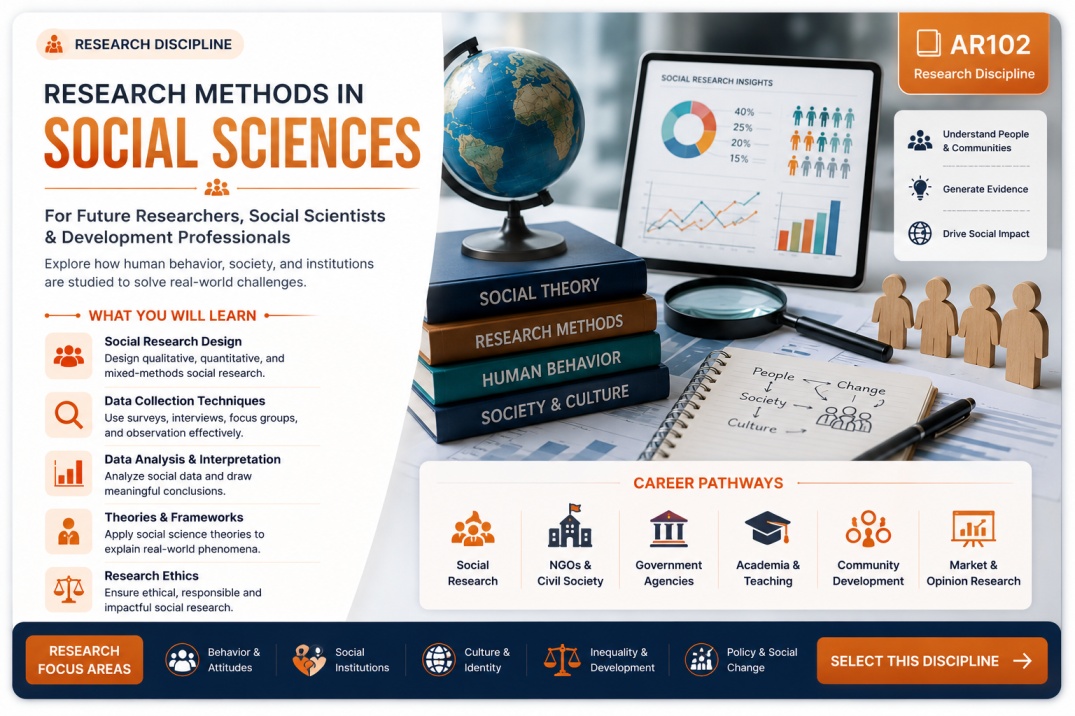
About Course
Research Methods in Social Sciences (AR102)
Course Overview
Understanding society requires more than observation. It requires systematic inquiry, critical thinking, and evidence-based analysis. Research Methods in Social Sciences equips students with the knowledge and skills needed to investigate human behavior, social institutions, cultures, communities, and contemporary social issues.
This course introduces students to the foundations of social science research and provides practical training in designing studies, collecting data, analyzing findings, and communicating results. Students will learn how researchers generate evidence that informs policy, development programs, education, governance, and social change initiatives.
Whether your interests lie in sociology, psychology, anthropology, development studies, political science, or related disciplines, this course provides a strong foundation for conducting meaningful and impactful social research.
What You Will Learn
Foundations of Social Science Research
-
Understand the purpose and value of social research
-
Explore major research paradigms and theoretical perspectives
-
Develop research questions and objectives
Research Design and Methodology
-
Distinguish between qualitative, quantitative, and mixed-methods approaches
-
Select appropriate research designs for social investigations
-
Develop research proposals and study plans
Data Collection Techniques
-
Design surveys and questionnaires
-
Conduct interviews and focus group discussions
-
Apply observation and field research methods
-
Use sampling techniques effectively
Data Analysis and Interpretation
-
Organize and manage research data
-
Analyze qualitative and quantitative findings
-
Identify patterns, relationships, and social trends
-
Draw evidence-based conclusions
Research Ethics
-
Protect participant rights and confidentiality
-
Apply ethical standards in social research
-
Understand informed consent and responsible data management
Academic and Professional Communication
-
Write research reports and policy briefs
-
Present findings clearly and persuasively
-
Apply proper referencing and citation techniques
Who This Course Is For
This course is ideal for:
-
Sociology students
-
Psychology students
-
Anthropology students
-
Development studies students
-
Political science students
-
Public administration students
-
NGO and development practitioners
-
Community development professionals
-
Researchers interested in understanding social issues and human behavior
No prior research experience is required.
How You Will Learn
Duration
3 Months
Format
Hybrid, combining engaging online lessons with interactive in-person classes.
Learning Style
Practical, hands-on, and student-paced, with real social datasets, case studies, field-based examples, and personalized feedback from instructors.
Throughout the Course You Will:
-
Participate in guided lessons and practical workshops
-
Analyze real-world social issues and case studies
-
Design surveys and interview guides
-
Practice data collection and interpretation techniques
-
Receive feedback from experienced researchers
-
Complete a mini social research project from conception to reporting
Learning Outcomes
Upon successful completion of this course, you will be able to:
-
Design and conduct social science research studies
-
Collect and analyze social data effectively
-
Apply ethical principles in research practice
-
Interpret findings and communicate evidence clearly
-
Contribute to informed decision-making, policy development, and social change initiatives
Course Code
AR102
Research Discipline
Social Sciences
Available In
Basic Research Program, Advanced Research Program, and Premium Research Program
Student Ratings & Reviews